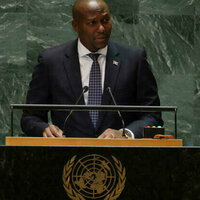


A high-level General Assembly conference on advancing the realization of two independent States — Israel and Palestine — concluded its general debate today, with the final outcome document circulated to delegations. The event will reconvene at a later date to take action on the text.
“States have until the beginning of September to endorse the document if they so wish,” said the representative of Saudi Arabia as he suspended the session.
Co-chaired by that country and France, the “High-Level International Conference for the Peaceful Settlement of the Question of Palestine and the Implementation of the Two-State Solution” was held pursuant to General Assembly resolution 79/81 from 28 to 30 July in New York. (For coverage of the 28 and 29 July meetings, see Press Releases PAL/2248 and PAL/2249, respectively.)
During the Conference’s general debate — featuring more than 120 speakers — some highlighted the historical significance of General Assembly resolution 181(II), adopted in November 1947, which outlined the foundational vision of a two-State solution.
States Support Two-State Solution, Malta Will Recognize Palestine in September
“It is totally unacceptable that 78 years since the adoption of General Assembly resolution 181, only one of the two States has enjoyed independence and full membership to the UN, while the other — the State of Palestine — continues to be denied,” said the representative of Malaysia, declaring: “It is time to end this historic and gross injustice.” Commending the countries that have announced bold decisions to recognize the State of Palestine, he called on others to do so urgently.
Malta became the latest country to announce its intention to recognize the State of Palestine, with its representative stating that formal recognition will be granted at the upcoming UN General Assembly session. He described this decision as “a concrete step towards the realization of a just and lasting peace”. Citing the International Court of Justice’s affirmation of the Palestinian right to self-determination, he stressed that recognition must be followed by “political willingness to negotiate from both sides” and the presence of “a legitimate Palestinian Government entrusted with a popular mandate”. However, “Hamas should not form part of the equation in Gaza’s future governance”, he added.
Similarly, the speaker for Bulgaria, recalling his country’s early recognition of the State of Palestine in 1988, emphasized the importance of recognizing Israel’s legitimate security concerns and establishing a unified, democratically elected Palestinian leadership — excluding Hamas — as the foundation for a viable and sovereign Palestinian State. Stressing that “peace is not a gift we offer one another, it’s a responsibility we owe to future generations”, he called for direct negotiations between the parties rooted in trust, compromise and practical solutions.
Kyrgyzstan’s delegate — recalling his country’s recognition of the State of Palestine in 1995 — welcomed similar moves by France and the United Kingdom during the Conference. Stressing that peace must be based on UN resolutions and the two-State solution, he further pledged support for international efforts to end the bloodshed and achieve lasting peace in the region.
The representative of Australia highlighted a joint declaration issued on 29 July by a group of Member States, reporting that his country and 14 others released the “New York Call” — which “makes clear that recognition of a State of Palestine is an essential step to a two-State solution”. Israel must engage on the question of Palestinian statehood. “The world is moving and a two-State solution is essential for Israel’s long-term security,” he observed, stressing that Australia will “keep working with other countries to make a two-State solution a reality”.
Speakers Spotlight United States’ ‘Complicity’
Meanwhile, the representatives of Iran and Cuba condemned the United States for its role in the Middle East. Citing a series of normalization agreements between Israel and several Arab countries that were brokered by the United States, the delegate from Tehran said that the “so-called Abraham Accords” emboldened Israel. That State, he said, launched “unprovoked attacks” on Iranian territory in June, targeting civilians and nuclear facilities “abetted with US direct engagement”. Calling for “targeted sanctions” against Israel, he warned against “any attempt to normalize relations with the Israeli occupying regime” as it constitutes “a betrayal of international law and justice”.
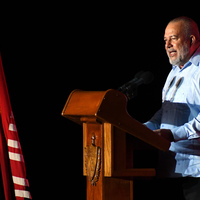
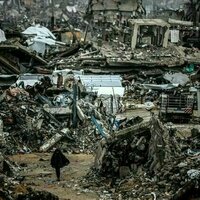
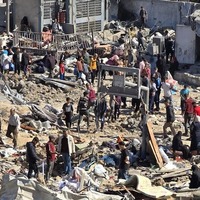
“It is impossible to talk of the situation in Palestine without speaking out about the historical complicity of the United States Government, which is also responsible for the genocide,” said the delegate from Havana, citing Washington, D.C.’s, repeated use of its veto in the Security Council to “block the implementation of a ceasefire”. The Council’s paralysis is an affront harnessed by Israel to continue its criminal policies without fear of consequence. Concrete action is urgently needed to halt the ongoing genocide and allow the unrestricted delivery of humanitarian aid, he added.
...