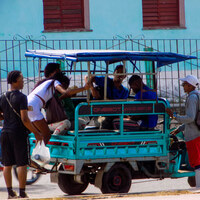



WASHINGTON (CN) - The Supreme Court grappled on Monday with the lengths the U.S. government could go to bring political change in Cuba.
Thirty years ago, Congress created a liability scheme to squeeze the communist regime and prevent profiteering off U.S. nationals' stolen property. But it took two decades for a president to wield the legislation.
During his first term, President Donald Trump released U.S. companies to seek compensation against foreign corporations that coordinated with the Cuban government to traffic their confiscated goods. The consequences of that decision came to a head at the Supreme Court on Monday as the justices probed how far the government could go to deter third party investment on the island.
"Is there any limit to how far Congress can go with this sort of poison pill remedy?" Justice Clarence Thomas, a George H.W. Bush appointee, asked.
Under the leadership of Fidel Castro, the Cuban government confiscated all U.S. property on the island in 1960, igniting a total trade embargo that only briefly thawed once over six decades.
Congress enacted the Cuban Claims Act creating a pathway for U.S. nationals to recoup the value of their seized property. The Foreign Claims Settlement Commission, an agency housed within the Department of Justice, certified thousands of claims against the Cuban government, but there were no Cuban assets in the U.S. to satisfy those claims.
In 1996, Congress passed the Cuban Liberty and Democratic Solidarity, or LIBERTAD Act - also known as the Helms-Burton Act - as a solution. Along with harsher sanctions, the law allowed U.S. nationals to go after companies working with the Cuban government to profit off their stolen goods.
Every six months between 1996 and 2018, U.S. presidents acted to suspend the provision, but former Secretary of State Mike Pompeo announced that it would go into effect in 2019.
Havana Docks Company, based in Delaware, responded with a suit against Carnival Corporation, a Panamanian company, for utilizing its piers for cruise visits between 2016 and 2019. A lower court dismissed the suit, however, finding that Havana no longer had ownership over the property.
During oral arguments, Justice Elena Kagan, a Barack Obama appointee, noted that Havana never owned the docks outright, instead holding a concession to operate the piers that ended in 2004.
Kagan said that there were boundaries on Havana's property interest.
"Once it's over, it's over," Kagan said.
Havana argued that its interest was in the use of the docks for 44 years even if their concession was supposed to end over two decades ago.
Justice Sonia Sotomayor, another Obama appointee, balked at Havana's claim, which she saw as vastly different from what the statute prescribed.
"You're entitled to interest up until you receive payment," Sotomayor told Havana. "But what you're seeking is something dramatically different. You're seeking not one compensation with interest; you're seeking infinite compensation forever."
Breaking with her liberal colleagues, Justice Ketanji Brown Jackson, a Joe Biden appointee, expressed frustration with debate over what should or should not be considered a property interest. She noted that Congress delegated that determination to the Foreign Claims Settlement Commission.
"The statute says anyone who owns a property interest as certified by the commission can make a claim that someone is trafficking in it and get relief or get the money that is associated with that activity in the statute," Jackson said. "So it seems pretty straightforward to me."
Exxon Mobile brought similar claims against Cuban-owned oil companies for operating out of refinery and service stations that were confiscated during Castro's regime. Typically, foreign states and their instrumentalities are immune from lawsuits in U.S. courts under the Foreign Sovereign Immunities Act.
But Exxon said the LIBERTAD Act stripped Cuban corporations of those protections.
"The 1996 Congress wanted to put crushing diplomatic and economic pressure on the Cuban government, that includes by abrogating the sovereign immunity of Cuban instrumentalities," Morgan Ratner, an attorney with Sullivan & Cromwell representing Exxon, said.
The complex debate consumed over three hours of oral arguments as the justices parsed varying factors in each appeal. However, Justice Samuel Alito, a George W. Bush appointee, questioned if the court's effort was worthwhile.
"Unless Cuban instrumentalities have property in the United States against which a judgement can be executed, what difference does all of this make as a practical matter?" Alito asked.
The federal government said there was value in having a judgment, suggesting that the ruling could be taken to courts in other countries.
Alito seemed unsatisfied with that response.
"It's kind of beyond me what the value of this judgment is going to be if it can't be executed in the United States, which seems likely," Alito said.
Source: Courthouse News Service